Electronics
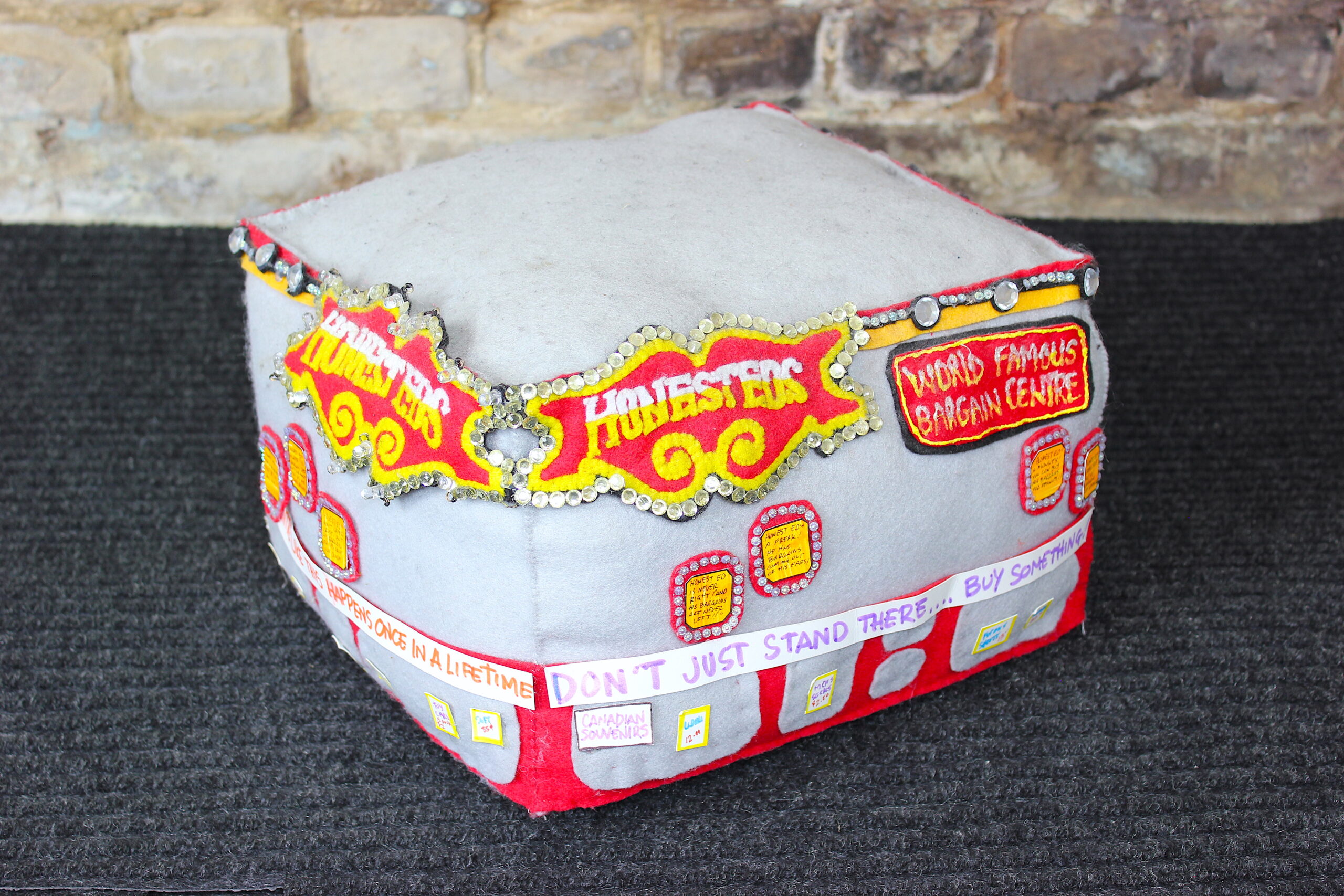

One of the Soft City’s last shows was at the closing party and exhibition for the iconic Honest Ed’s department store. Honest Ed’s was known and beloved for its over-the-top, maximalist, tackiness-as-lifestyle aesthetic. As the makers of a soft city, we obviously had to add the store to our collection of miniature buildings for the show, and had to include lights. Sarah Couture-McPhail and I split the job of making the 2 main buildings and their associated signs. I wired both with lights. Mine, on the right above, used a simple circuit of automatically-blinking LEDs and battery. Sarah’s, below, was wired up to an Arduino board that I programmed so that the lights would appear to move around in circles clockwise, reverse direction, then blink, and repeat. To achieve the effect I used a stroboscopic illusory motion trick I knew from research on visual perception, where when lights next to each other flash on and off in quick succession, they appear to move, just as when you’re watching a film, your visual system combines the stimuli from multiple static frames into fluid motion.
Interactive Stained Glass
In collaboration with Sara Nabil’s iStudio Lab at Queen’s, we explored how hybrid crafts (the blend of traditional craft practices with input/output interaction design) can be robustly deployed beyond the studio or speculative designs in homes. Interactive stained-glass interfaces were co-designed with participants, and embedded in 3 households. The 2026 paper demonstrates how interactive crafted artefacts are lived with, and perceived as situated technologies in everyday environments. For this project I co-supervised several undergraduate students doing a capstone project, and advised on ethics.
The Hypersensory Homonculus
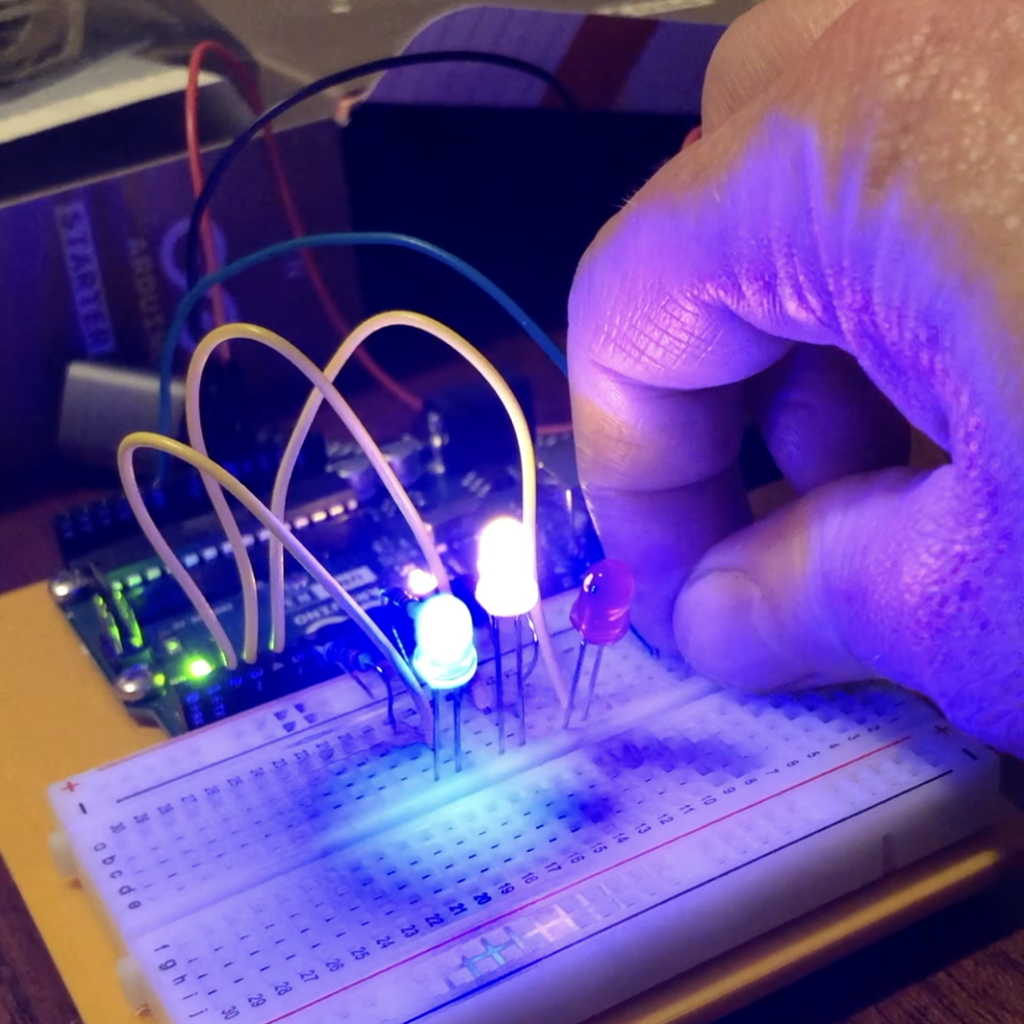
In collaboration with Julian Pivato (UTSC, Arts, Culture and Media), I am developing a performance piece in which Julian will wear and interact with a costume I am constructing. The costume is inspired in part by illustrations in neuroscience textbooks of the sensory homunculus. Along a strip of parietal cortex going from the top of the head to the ear are brain areas responsible for sensory processing. (There is an adjacent area responsible for motor control.) The areas sensitive to touch on different areas of the body are laid out in a distorted map of the body. Representations of this map are drawn as a little person (homunculus) showing the sizes of the body parts in proportion to the area in the brain responsible for them. Areas like the hands, face and genitals that have denser innervation are disproportionately big.
The idea for the costume is to turn sensory processing inside out, showing the sensory homunculus on the outside by placing sensors and actuators in the costume, exploring the sensitivity of our nervous systems, and how we essentially do wear our most intimate selves on the outside (the retina at the back of the eye is part of the brain, for example). The performance will highlight how neurospicy brains can be extra sensitive to some kinds of stimuli. We queer the homunculus turning it into a homonculus, to explore how on queer/trans bodies some areas are always under heightened alert. The costume has exaggerated external genitalia, with an extra large clitoris hanging out, and ridiculously large extra nipples all along the mammary crest (milk line). It is also studded with LED lights, sensors, buzzers and switches, which will be activated at different points in the performance. The clitoris will contain a proximity sensor connected to buzzers through a digital theremin circuit, translating anxieties about dysphoria and sexual trauma into noise.